Redesigning a Dating App Interface to Reduce Implicit Racial Bias
Background
Photo-first dating interfaces encourage rapid, appearance-based judgments. Drawing on dual-process accounts of decision making, we tested whether showing profile compatibility before a photo changes racial bias in users' choices.
The experiment also tested an update interface: participants made an initial decision, saw a compatibility score, and could revise their choice.
Study design
We compared five interfaces to separate the effects of information order, compatibility scores, and a chance to reconsider an initial choice. A total of 1,907 participants were randomly assigned to one interface and evaluated 15 controlled profiles.
My Role
I led this study end-to-end: defining the problem, designing the experimental interfaces, building the simulation, recruiting participants, and analyzing results. This work was conducted under the guidance of Prof. Krzysztof Gajos, who provided research mentorship and co-authored the final publication.
Methods
We conducted a large-scale between-subjects online experiment on LabintheWild to investigate how interface design affects racial bias in dating decisions. Our experiment tested five different dating interface designs:
- Swipe (Baseline): Participants viewed a name and photo and responded with a like/dislike, simulating a standard dating app.
- Swipe + Match Score: Added a numeric compatibility score to the baseline design.
- Update Interface: Participants made an initial decision, saw the match score, and had a chance to revise.
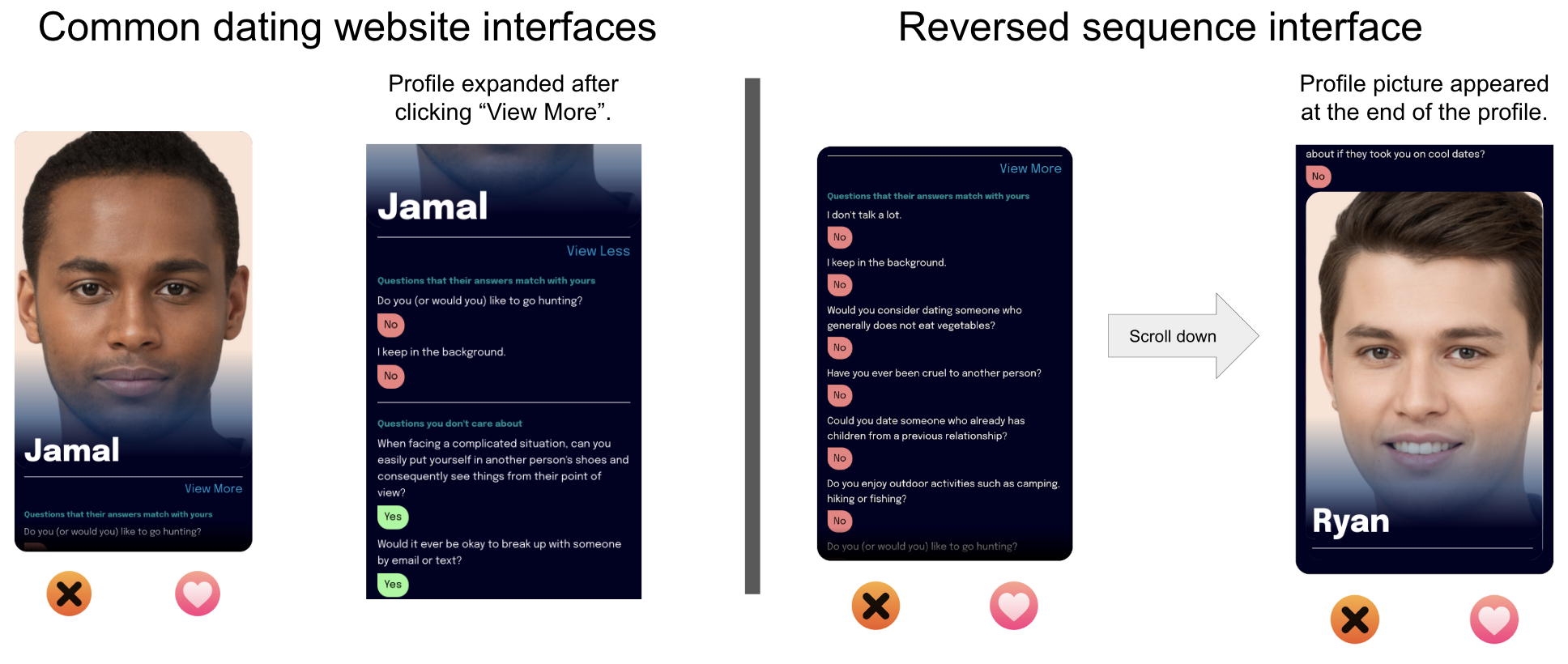
- Reversed Sequence: Participants saw profile details (interests, answers to check-in questions) before seeing the photo and name.
- Combined: Used both the reversed sequence and update mechanisms.
Participants (N = 1,907) were randomly assigned to one interface. They interacted with 15 profiles (5 Asian, 5 Black, 5 White) across varying match scores. Profiles were controlled for attractiveness using crowdsourced ratings and constructed from generated photos and match scores based on user-defined preferences.
Interface Comparison
Left: Traditional photo-first interface. Right: Our redesigned interface presenting profile details first.
Results
In the reversed-sequence condition, participants saw compatibility information before names and photos. Anti-Black bias was lower in this condition (OR = 0.78, p = 0.018). The update condition alone did not reduce bias.
Participants in the reversed-sequence condition also spent more time evaluating profiles.
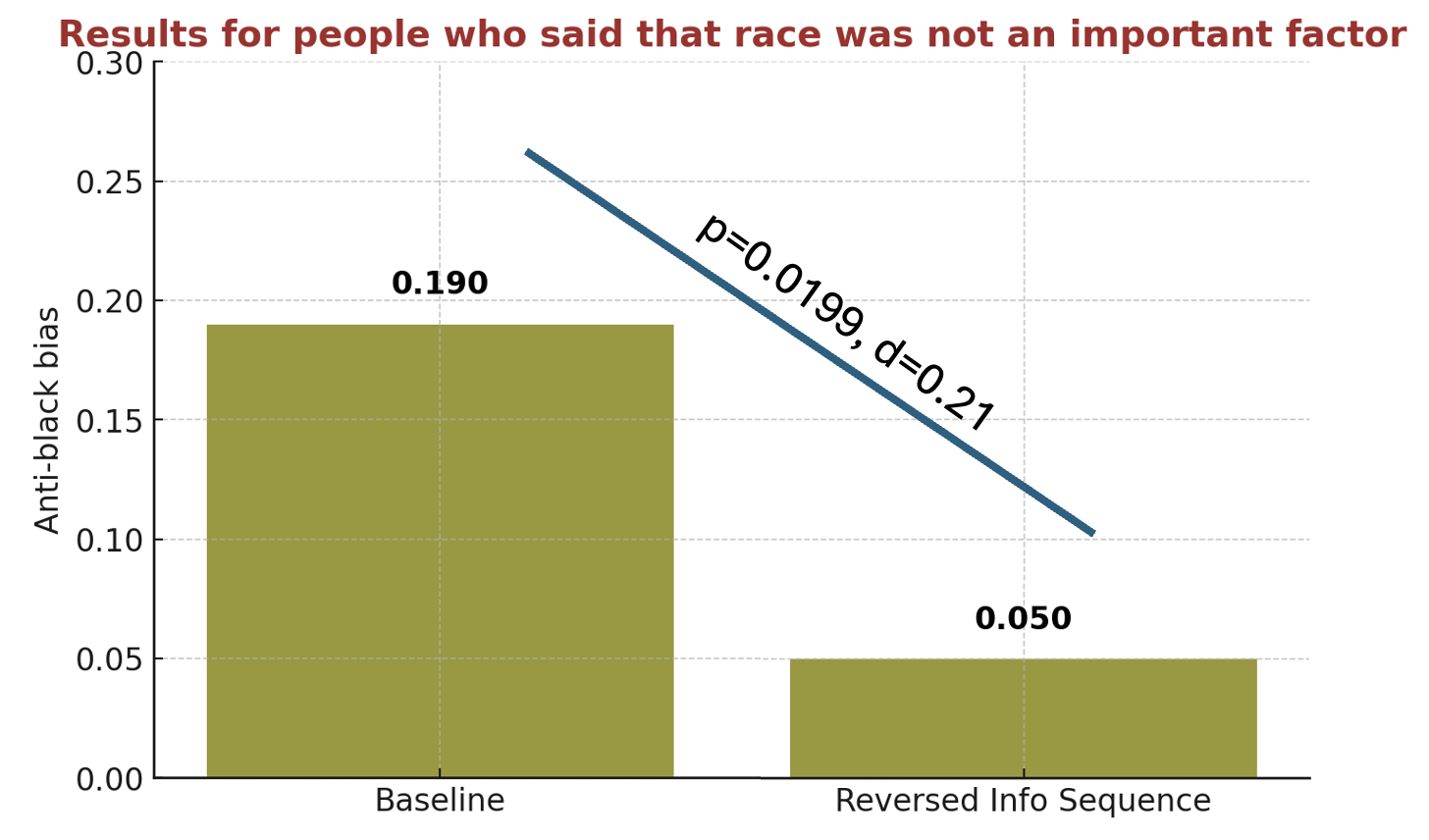
Racially biased choices by interface condition.
Not Just a Preference: Reducing Biased Decision-making on Dating Websites
Proceedings of the 2022 CHI Conference on Human Factors in Computing Systems
Paper