Designing AI Tools for Humanitarian Negotiation
Background
Frontline Associates, a global network of humanitarian negotiators, approached my team to investigate how AI could support their negotiation workflows. As conflicts intensify globally, these negotiators sought guidance on whether LLMs could responsibly support their highly contextual and relational work.
Humanitarian negotiations are ethically complex and emotionally demanding. Negotiators—often working unarmed under political pressure—must engage with actors ranging from tribal leaders to armed groups. While they've begun experimenting with LLMs to synthesize information and prepare for engagements, current AI tools prioritize outcome optimization rather than supporting the human, iterative processes critical to this work.
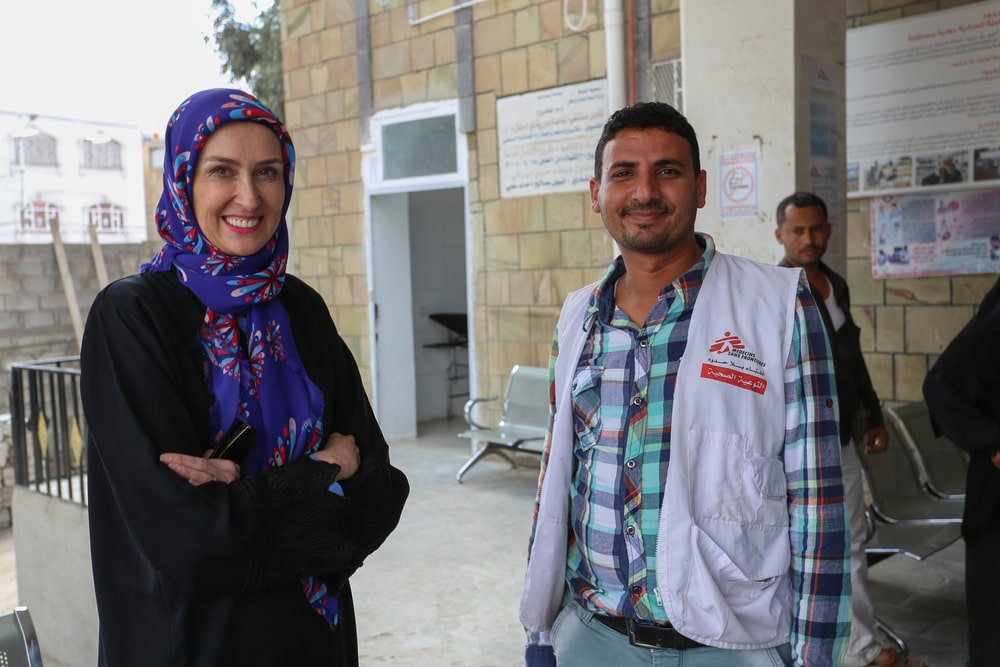
Liesbeth Aelbrecht visited an MSF team working in the General Rural Hospital of Dhi As Sufal district in the south of Ibb Governorate, in Yemen. (Photo: MSF/Majd Aljunaid) Source
Problem
Negotiators at organizations like MSF, UN, and ICRC are turning to AI, but existing tools don't align with their workflows. My research revealed they need structured, context-aware assistance that preserves negotiator agency and aligns with established frameworks like Iceberg and Island of Agreements. To address this, I designed and evaluated an AI-powered interface tailored to negotiation preparation.
My Role
I led this project end-to-end as designer, developer, and UX researcher. Key responsibilities included conducting formative interviews, building the probe interface, leading a comparison study between ChatGPT and my interface, facilitating synthesis workshops, and collaborating with practitioners to ground the design in real-world constraints.
Methods
I used affinity diagramming extensively in both studies to synthesize qualitative data. After transcribing interviews and study sessions, I grouped quotes and observations on virtual whiteboards to identify emerging themes. This method allowed me to contrast experiences with ChatGPT and my custom probe interface, helping surface insights around usability, collaboration, and alignment with negotiation workflows.
I partnered with Frontline Associates, a global NGO network of negotiators, to run the study. My work unfolded in two phases:
Phase 1: Formative Research
- Conducted 14 interviews with negotiators from MSF, UN, and ICRC
- Identified key tasks: context analysis, compromise ideation, risk assessment
- Mapped major concerns: confidentiality, bias, overreliance
Phase 2: Design Probe Study
- Ran a within-subjects think-aloud study with 18 negotiators
- Each participant prepared a negotiation plan first using ChatGPT, then my custom probe
- Used open coding and thematic analysis across transcripts
- Synthesized findings into journey maps and iterated on the interface
Personas & User Stories
These personas emerged from my formative study with 14 humanitarian negotiators and directly informed the design requirements of the probe interface. Amina's persona represents concerns about AI overreach and loss of agency, while Luis embodies newer negotiators who struggle with complex frameworks.
Primary Persona: Amina, Experienced Field Negotiator
Goals
Build trust with counterparties, make ethically grounded decisions, pass on negotiation strategies to less experienced colleagues
Frustrations
LLMs offer "overconfident" advice; require too much prompt engineering; lack sensitivity to local norms
User Story
"As a senior negotiator, I want AI tools that help me organize negotiation knowledge without automating away my judgment."
Secondary Persona: Luis, Early-Career Regional Negotiator
Goals
Learn effective practices, reduce prep time, avoid errors
Frustrations
Chat interfaces are overwhelming and unstructured; difficult to learn frameworks like Iceberg CSS alone
User Story
"As a new negotiator, I want AI to guide me through strategy frameworks so I can build better cases and learn from experts."
Design Process & Sketches
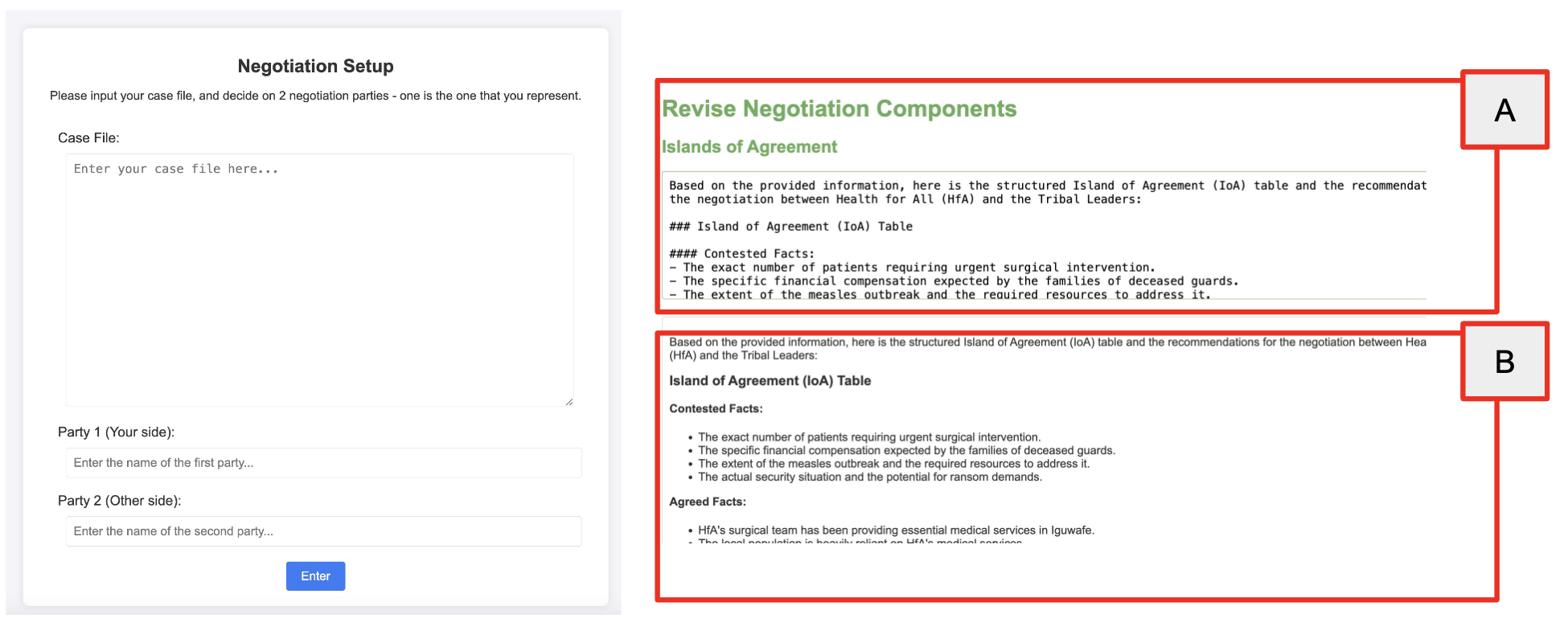
Before implementation, I created low-fidelity sketches to explore concepts with subject matter experts. These visualizations clarified how to scaffold negotiators' workflows using frameworks like Island of Agreements and Iceberg CSS, while helping me pivot from an outcome-based to a process-oriented approach.
Iterative testing with negotiators shaped key design decisions such as editable markdown summaries, simplified risk visualizations, and strategic organization of negotiation tiers.
Probe Interface Implementation
I implemented the interface as a full-stack web application using React for the frontend and Node.js with Express for the backend. The interface integrated with the OpenAI API to provide context-sensitive assistance while maintaining negotiator control through carefully designed interaction patterns.
Technical Implementation
- Built a modular component architecture to handle different negotiation frameworks
- Implemented state management to track negotiation progress and allow for collaborative review
- Created custom prompt engineering templates to maintain consistency while providing targeted assistance
- Developed a markdown-based editing system that balanced structure with flexibility
Click to view full image
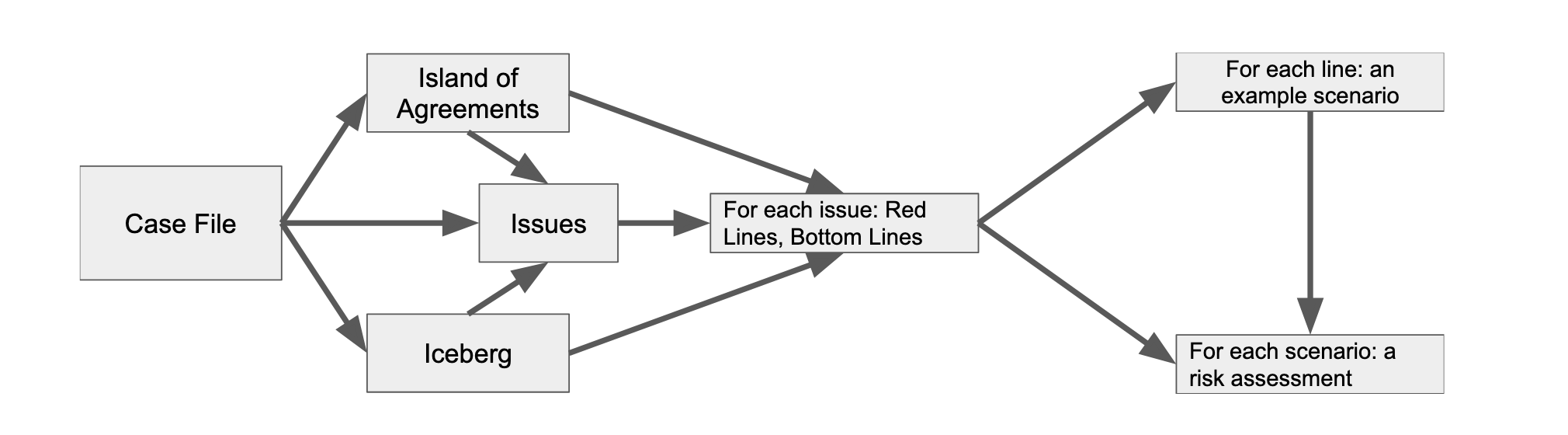
The probe interface was designed as a guided workflow with four key modules, each addressing a specific negotiation preparation need:
- Context Analysis - Structured input forms for capturing situation details and stakeholder positions
- Framework Application - Interactive tools applying Iceberg CSS and Island of Agreements methodologies
- Position Mapping - Visual interface for identifying red lines, bottom lines, and zones of agreement
- Risk Assessment - AI-assisted identification of potential issues with negotiator-led validation
Each module leveraged AI capabilities while maintaining human judgment at decision points. The AI components were designed to suggest rather than decide, providing options that negotiators could accept, modify, or reject within their established workflows.
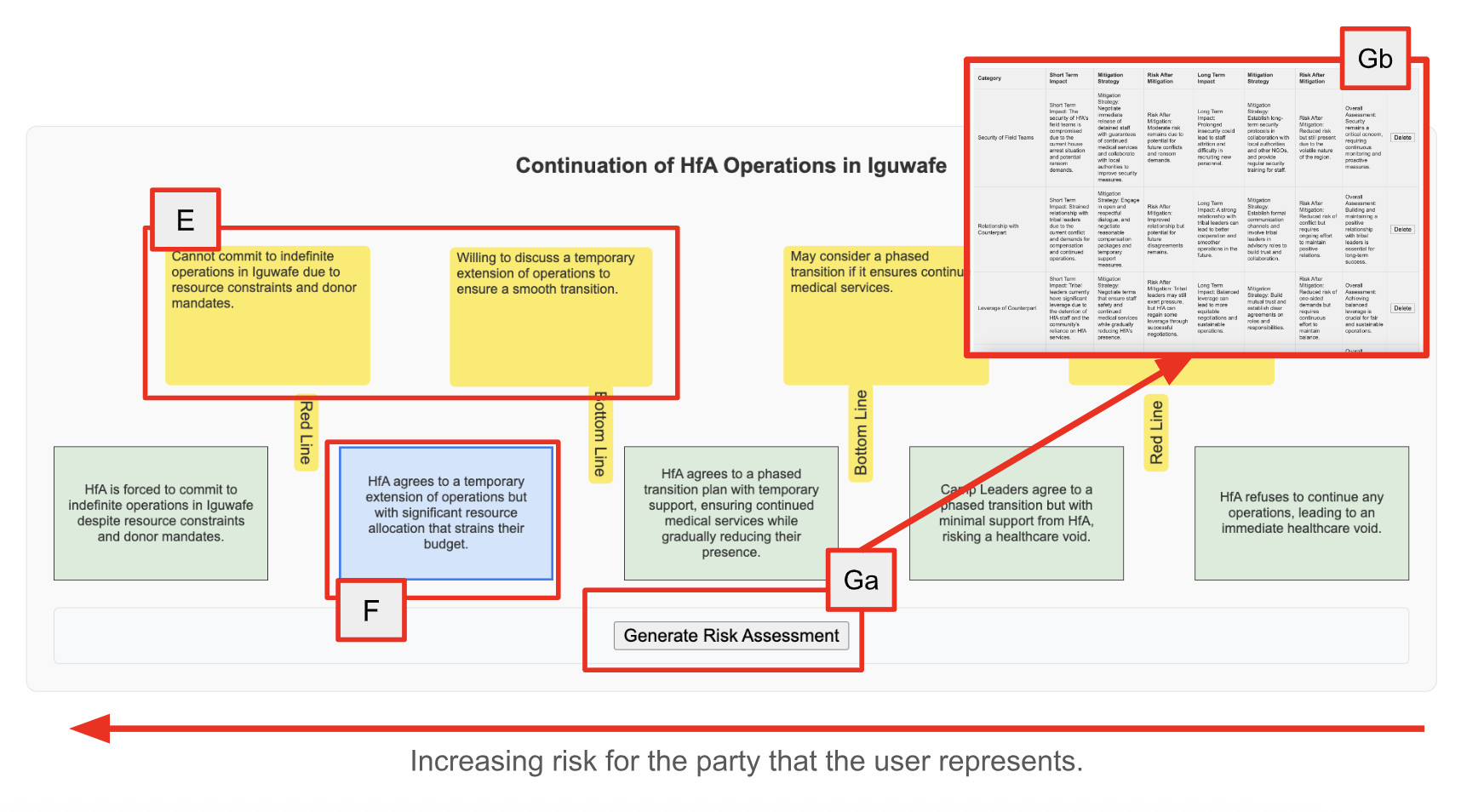
These visual explorations grounded my interface in the real cognitive processes of negotiation, informed the probe's modular architecture, and allowed me to align the final design with the participants' mental models.
Final Design & Key Findings
Probe Design Implementation
- Step-by-step workflow integrating established negotiation frameworks
- Custom LLM prompt templates that maintain ethical boundaries
- Editable, structured outputs that preserve human oversight
- Progressive disclosure interface reducing cognitive load
Key Results
- Negotiators preferred my interface over ChatGPT for its transparency and alignment with frameworks
- Novices gained structure while experts retained flexibility
- The interface reduced bias and encouraged team-based validation
Implementation Challenges & Solutions
Developing the probe interface required balancing several competing requirements:
Challenge: Contextual Understanding
LLMs struggled with the nuanced geopolitical contexts of negotiations
Solution:
Implemented a pre-processing layer where negotiators could verify and correct contextual information before framework application
Challenge: Maintaining Agency
Early prototypes sometimes overrode negotiator judgment
Solution:
Redesigned to provide suggestions with explicit "accept/modify/reject" controls in each module
Through iterative user testing, I refined the implementation to better match negotiators' mental models. Key improvements included simplifying the UI, adding collaborative annotation features, and providing clearer pathways between negotiation framework stages.
Impact
Deliverables
- A deployed design probe tested in two studies
- Published at CHIWORK 2025
- Shared with 200+ professional negotiators through the AI in Negotiation Workshop, hosted by Frontline Associates (workshop PDF)
Outcomes
- Disseminated findings to MSF, UN, ICRC, and others via weekly workshops with over 20+ participants each week
- Helped shape professional guidelines on AI use in negotiation
- Reinforced the need for process-oriented AI in high-stakes, human-centered fields
"ChatGPT, Don't Tell Me What to Do": Designing AI for Context Analysis in Humanitarian Frontline Negotiations
Proceedings of the 4th Annual Symposium on Human-Computer Interaction for Work (CHIWORK '25)
DOI arXivUsing Large Language Models for Humanitarian Frontline Negotiation: Opportunities and Considerations
ICML 2024 Next Generation of AI Safety Workshop
Paper